

Pubrio reads every expansion along a few independent axes: the stage a company has reached, the signals behind it, the local presence it already has, and the momentum, freshness, and flow direction of the move. The API value columns below are exactly what you’ll see in responses and can filter on. For an always-current list, call the Expansion Taxonomy endpoint.
The Expansion Stages
Every company-and-market pair sits at a stage. The stages form a ladder from first interest to a fully established operation.
The expansion stages rise in commitment—each backed by characteristic signal types.
Exploring
exploring — early interest: advertising or news activity aimed at the region, before any commitment.Committing
committing — resources going in: partnerships, infrastructure, and other groundwork.Expanding
expanding — a foothold forms: local hiring, in-region leadership, or a physical office.Scaling
scaling — actively running: scaling the team and launching products locally.A single piece of activity does not move a company up a stage — Pubrio looks for a corroborated pattern first.
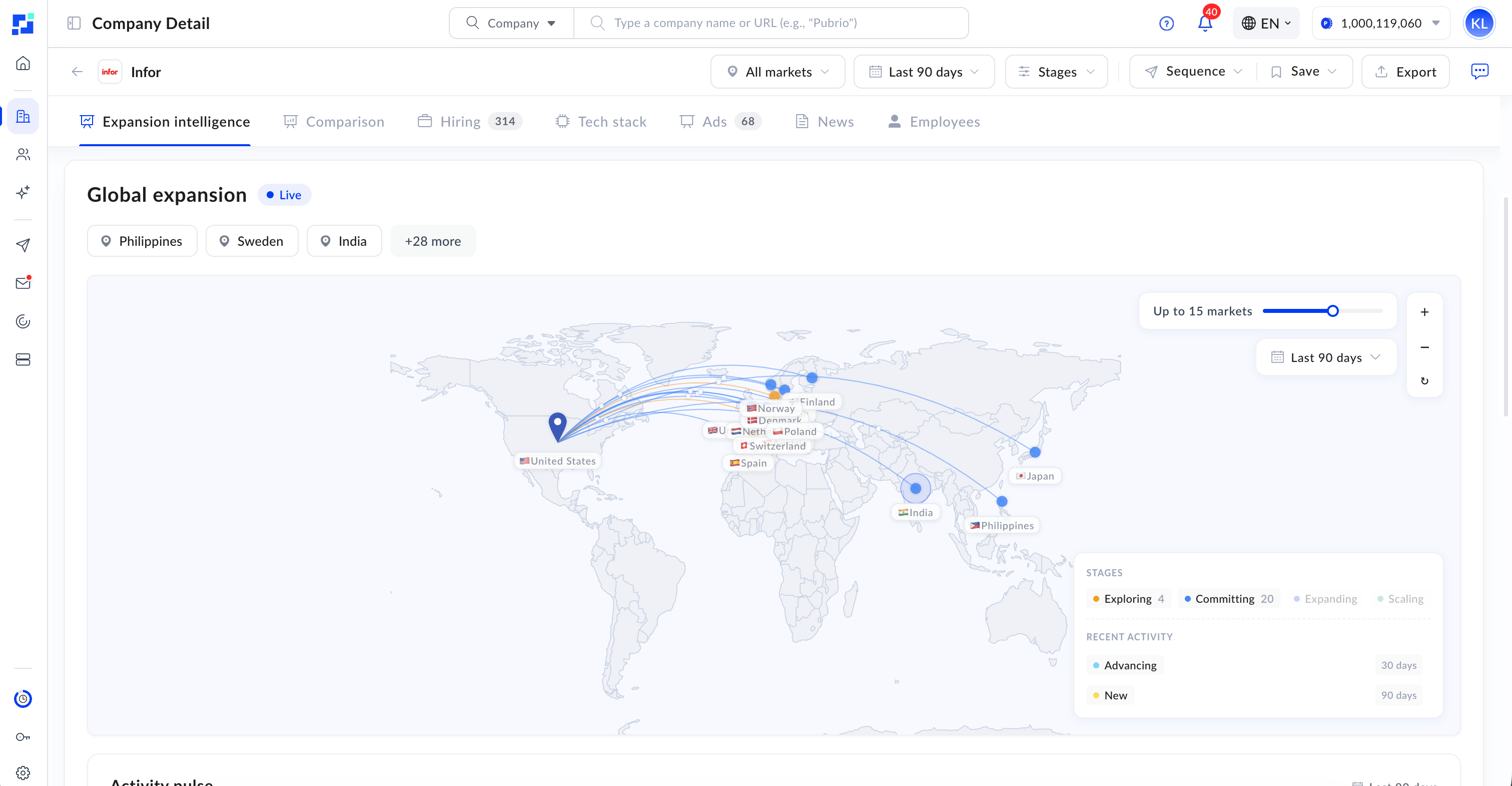
The same four stages, live on a company's expansion map — each market pinned, colored by where it sits on the ladder.
Two axes: expansion signals vs. local presence
Pubrio reads a company’s position on two independent axes, and the API surfaces both — which is why the same company can show an active expansion stage and an established local footprint at the same time.Signal stage
Derived from active expansion signals — hiring, ads, news, a new office. Answers “what is the company doing to enter this market right now?” (
exploring → scaling).Local presence
Derived from the company’s actual footprint — the size of its detected in-market team and any known office. Answers “what does the company already have on the ground?”
- A company can be
committingorexpandingby signals while already showing a sizeable local team — it has a foothold and is actively deepening it, not entering cold. The in-market presence overlay reads this as scaling / deepening rather than a fresh entry. - A market with a real local presence but no active expansion signals surfaces with a
presence.levelofestablished— a long-standing operator that isn’t making new moves right now. These are excluded from new-expansion views by default; include them (is_include_established) when you want the full footprint.
Signal Types
Each signal type points to the stage it most strongly indicates. Premier signal types are higher-prominence indicators.Advertising
AD · Exploring · StandardCampaigns targeted at the market’s audience.
News
NEWS · Exploring · StandardFunding, partnerships, and launch coverage tied to the region.
Capital investment
INFRA · Committing · PremierCapital committed to the market through investments and acquisitions.
Cloud footprint
DNS · Committing · PremierCloud infrastructure detected in the market.
Partnerships
PARTNER · Committing · StandardLocal partnerships and channel relationships.
Exhibiting / speaking
EVENT_PLUS · Committing · PremierSpeaking or exhibiting at an event in the target market.
Executive hiring
EXEC · Expanding · StandardLeadership roles based in the market.
Office / presence
OFFICE · Expanding · StandardA physical office or registered presence.
Local hiring
HIRE · Expanding · StandardOperational roles posted in the market.
Scaling
SCALE · Scaling · StandardGrowing the local team and operations.
Product launch
PRODUCT · Scaling · StandardProducts or services launched locally.
Hiring signals (
HIRE, EXEC) are often the earliest concrete evidence of a market move and frequently tell you which function is expanding — sales, engineering, or operations — via the underlying job data.Expansion Score and Confidence
Expansion score
How significant and active the expansion is. Sort by it so the most decisive movers rise to the top of a market.
Confidence
How much corroborating evidence exists — a company with several independent signals reads more confidently than one resting on a single source.
Momentum, freshness, and flow
Beyond the stage, each expansion carries a momentum, a freshness, and a flow direction. These are independent filters you combine to express exactly the query you want.- Momentum
- Freshness
- Flow
- Strength
The trajectory of the move through the stages.
Polarity: expansion vs. contraction
Most signals indicate growth, but Pubrio also detects contraction — evidence that a company is scaling back. Each signal carries a polarity, so you can spot retreats as clearly as advances (useful for churn-risk monitoring).Putting it together
Field Reference
Every request filter and response field, with types and values.
Worked Example
Walk one company’s expansion end to end.